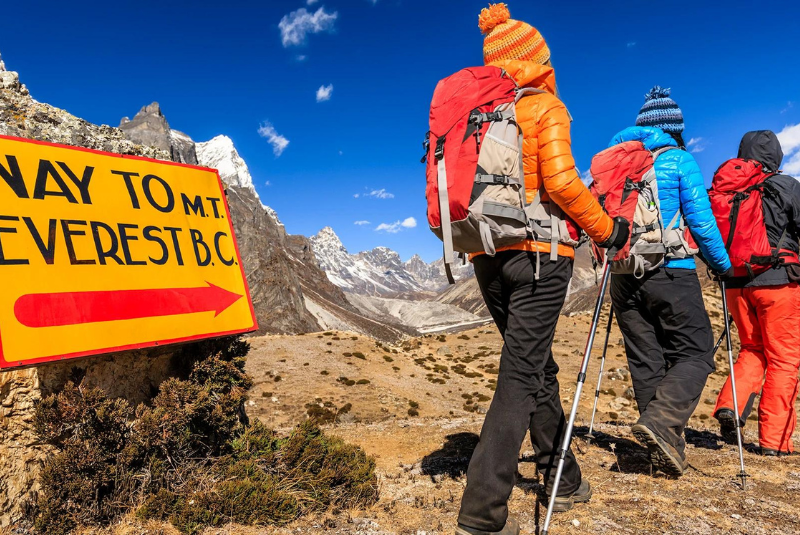
The Everest Base Camp (EBC) trek in 2027 takes 12 days Lukla to Lukla, costs about US$1,300–2,200 with a guide, and is best done in October–November or March–May. It needs no climbing skills, only good fitness and slow acclimatization. Below are straight answers to the questions trekkers ask most.
Quick facts | 2027 |
|---|---|
Highest point | Kala Patthar 5,545 m (EBC itself 5,364 m) |
Standard length | 12 days Lukla–Lukla (14 days with Kathmandu) |
Total walking | About 130 km round trip |
Grade | Moderate to strenuous (altitude is the challenge) |
Permits | Sagarmatha National Park + Khumbu Pasang Lhamu Rural Municipality (no TIMS) |
Best months | October, November, March, April, May |
Typical guided cost | US$1,300–2,200 per person |
Table of contents Show
How much does a 12-day trek to Everest Base Camp cost?
A 12-day guided EBC trek costs about US$1,300–2,200 per person in 2027, including Lukla flights, permits, a guide, lodges and meals. Independent trekkers can spend around US$1,000–1,400; comfort-lodge packages run US$2,500–4,500.
Cost item | Approx. price (USD) |
|---|---|
Kathmandu–Lukla return flight | 440–500 |
Permits (park + municipality) | 45–55 |
Licensed guide | 30–40 per day |
Porter (carries up to 20–25 kg) | 25–30 per day |
Tea house room | 5–20 per night (higher near EBC) |
Meals | 25–45 per day |
Wi‑Fi, charging, hot shower | 3–8 per item |
Travel insurance (to 6,000 m, heli rescue) | 100–200 |
Tips for guide and porter | 10–15% of their wages |
Prices rise with altitude: food and water at Gorak Shep cost two to three times Namche prices. Budget an extra US$150–250 for snacks, drinks and weather delays at Lukla.
How many days to do the Everest Base Camp trek?
Most trekkers need 12 days from Lukla and back, or 14 days counting arrival and departure in Kathmandu. That allows 8 days up (with two rest days) and 3–4 days down. Fit, already-acclimatized trekkers sometimes manage 10–11 days, while Gokyo or Three Passes variations take 15–19 days.
Day | Route | Altitude |
|---|---|---|
1 | Fly to Lukla, trek to Phakding | 2,610 m |
2 | Phakding to Namche Bazaar | 3,440 m |
3 | Acclimatization day in Namche (Everest View Hotel hike) | 3,440 m |
4 | Namche to Tengboche | 3,860 m |
5 | Tengboche to Dingboche | 4,410 m |
6 | Acclimatization day in Dingboche (Nangkartshang hike) | 4,410 m |
7 | Dingboche to Lobuche | 4,940 m |
8 | Lobuche to Gorak Shep and Everest Base Camp | 5,364 m |
9 | Kala Patthar sunrise, descend to Pheriche | 5,545 m / 4,240 m |
10 | Pheriche to Namche Bazaar | 3,440 m |
11 | Namche to Lukla | 2,860 m |
12 | Fly Lukla to Kathmandu (spare day advised) | 1,400 m |
In peak seasons, Lukla flights often run from Ramechhap (Manthali), a 4–5 hour drive from Kathmandu. Keep one or two buffer days for weather.
What is the hardest day of the Everest Base Camp trek?
The hardest day is Day 8: Lobuche (4,940 m) to Gorak Shep, on to Everest Base Camp (5,364 m) and back to Gorak Shep. It covers about 12–15 km in 7–9 hours over rocky moraine, with roughly half the oxygen of sea level.
The next morning's pre-dawn climb up Kala Patthar (5,545 m) is a close second: steep, cold (often −10 to −15 °C) and the highest point of the trek. Early in the trek, the 600 m climb from Phakding to Namche Bazaar on Day 2 is the toughest stretch for legs and lungs.
How difficult is it to trek to Everest Base Camp?
The EBC trek is moderate to strenuous: the trail itself is non-technical, but altitude above 4,000 m makes every step harder. Expect 5–7 hours of walking a day, 10–15 km, with steep ascents and descents and stone steps.
What makes it hard:
- Altitude: the body has to adapt to under 60% of sea-level oxygen from Dingboche upward.
- Cold: nights drop below −10 °C above Lobuche in autumn and spring.
- Basic comfort: shared toilets, unheated rooms, limited showers higher up.
- Consecutive days: 12 days of walking with only two rest days.
Can a beginner do the Everest Base Camp trek?
Yes. A beginner with good general fitness can reach Everest Base Camp; no mountaineering experience or ropes are needed. Success depends more on pacing and acclimatization than on previous treks.
To prepare, beginners should:
- Train for 8–12 weeks: hiking with a 6–8 kg pack, stair climbing, and cardio 4–5 times a week.
- Do at least two long day hikes of 5–7 hours before departure.
- Choose a 12–14 day itinerary with two acclimatization days.
- Hire a licensed guide or guide-porter for route finding and altitude monitoring.
What is the oxygen level at Everest Base Camp?
At Everest Base Camp (5,364 m) each breath holds about 50% of the oxygen available at sea level. The air is still 20.9% oxygen, but air pressure is roughly half, so the effect is like breathing about 10–11% oxygen at sea level.
Place | Altitude | Oxygen vs sea level |
|---|---|---|
Namche Bazaar | 3,440 m | about 66% |
Dingboche | 4,410 m | about 58% |
Everest Base Camp | 5,364 m | about 50% |
Kala Patthar | 5,545 m | about 49% |
Blood oxygen saturation (SpO2) of 80–88% is common at EBC for healthy trekkers; guides check it daily with a pulse oximeter.
Which is harder, Kilimanjaro or Everest Base Camp?
Kilimanjaro's summit day is harder, but Everest Base Camp is the longer and more sustained trek. Kilimanjaro goes higher in fewer days with a brutal overnight summit push; EBC spends more days at altitude but acclimatizes more gradually.
| Everest Base Camp | Kilimanjaro |
|---|---|---|
Highest point | 5,545 m (Kala Patthar) | 5,895 m (Uhuru Peak) |
Duration | 12–14 days | 6–8 days |
Ascent rate | Gradual, two rest days | Fast, often 1 rest day |
Hardest day | 7–9 hrs to EBC and back | 12–15 hrs summit night |
Accommodation | Tea houses (lodges) | Tents (Marangu route huts) |
Main challenge | Many days above 4,000 m | Rapid gain and summit night |
If you handle long multi-day hiking well, EBC will feel easier. If you prefer a short trip and can push hard for one night, Kilimanjaro suits you.
Do I need a permit for Everest Base Camp?
Yes. Every foreign trekker needs two permits for the EBC trek, about US$45–55 in total. The TIMS card is not required in the Khumbu region; the local municipality permit replaced it.
Permit | Cost (foreigners) | Where to get it |
|---|---|---|
Sagarmatha National Park entry | NPR 3,000 (about US$22–25) | Nepal Tourism Board, Kathmandu, or Monjo gate |
Khumbu Pasang Lhamu Rural Municipality | NPR 2,000–3,000 (about US$15–22) | Lukla counter after landing |
SAARC nationals pay a reduced park fee, and Nepali citizens pay a nominal fee. Carry your passport and permit cards; they are checked at Lukla, Monjo and other village checkpoints. Unlike Annapurna or Langtang, the Khumbu currently has no mandatory-guide rule, though a licensed guide is strongly advised. Fees and rules can change, so confirm with your operator before departure.
How long does it take to walk from Everest Base Camp to the summit?
The final summit push from Everest Base Camp takes about 4–5 days, but only after 4–6 weeks of acclimatization rotations on the mountain. A full Everest expedition lasts around 60 days from Kathmandu.
The usual push goes Base Camp to Camp 2 (6,400 m), Camp 3 (7,200 m), South Col/Camp 4 (7,950 m), then an overnight climb of 8–12 hours to the 8,848.86 m summit. This is technical mountaineering through the Khumbu Icefall, not trekking; it needs an expedition permit (US$15,000 in spring from 2025), prior high-altitude experience and supplementary oxygen.
How risky is the Everest Base Camp trek?
The EBC trek is low to moderate risk for prepared trekkers; altitude sickness is the main danger, and it is preventable with slow ascent. Thousands of people complete the trek each season, and serious incidents are rare among those who acclimatize and descend when symptoms appear.
Risk | How to reduce it |
|---|---|
Acute mountain sickness (AMS) | Climb no more than 300–500 m of sleeping altitude per day above 3,000 m; take rest days |
HAPE / HACE (severe altitude illness) | Descend immediately if breathless at rest, confused or unsteady |
Lukla flight delays | Keep 1–2 spare days; flights depend on clear weather |
Cold and exposure | Four-season sleeping bag, down jacket, layers |
Trail hazards (yaks, rockfall, ice) | Stand on the mountain side when yaks pass; walk with a guide |
Stomach illness | Treat water, eat freshly cooked food |
Buy travel insurance that covers trekking to 6,000 m and helicopter evacuation. After the 2025–26 crackdown on fake rescue claims, insurers check evacuations more closely, so only call a helicopter for a real medical need.
Which month is best for the Everest Base Camp trek?
October and November are the best months for the EBC trek, with the clearest skies and most stable weather. March, April and May are the second-best window, with warmer days, blooming rhododendrons and expedition tents at Base Camp.
Season | Months | Conditions | Verdict |
|---|---|---|---|
Autumn | Oct–Nov | Clear views, dry trails, cold nights, busiest | Best |
Spring | Mar–May | Mild days, some afternoon haze, expedition season | Excellent |
Winter | Dec–Feb | Very cold (−20 °C at night), quiet trails, some lodges closed | For experienced trekkers |
Monsoon | Jun–Sep | Rain, cloud, leeches low down, frequent Lukla delays | Least recommended |
For fewer crowds with good weather, aim for early March or late November and book Lukla flights and lodges two to three months ahead.