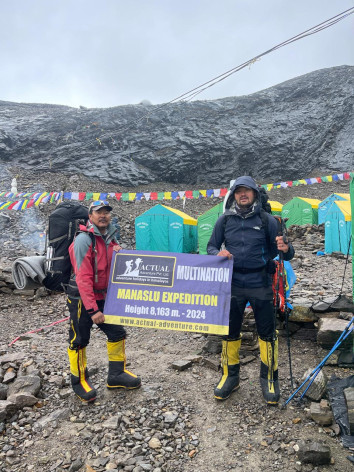
The easiest 6,000m peaks in Nepal are Mera Peak (6,476m), Island Peak (6,165m), Lobuche East (6,119m), Pisang Peak (6,091m), Chulu West (6,419m) and Tharpu Chuli/Tent Peak (5,663m, the warm-up option). Each can be climbed in 2–3 weeks by a fit trekker with a short glacier course, a licensed guide and a good acclimatization plan.
Table of contents Show
Why a 6,000m peak should be your first Himalayan summit
Most of these are "NMA peaks", mountains managed by the Nepal Mountaineering Association as a bridge between trekking and expedition climbing. They need a climbing permit, but no oxygen, no fixed-camp expedition and no previous 7,000m experience.
What "easy" really means. No 6,000m summit is easy. "Easy" here means non-technical to moderately technical: walking on a glacier roped up, using crampons and an ice axe, and in some cases a short fixed-rope section of 40–50°. The real challenge is altitude, cold and a 10–14 hour summit day, not climbing skill.
Who this guide is for: trekkers who have done Everest Base Camp, Annapurna Circuit or a similar 5,000m route and want to stand on their first Himalayan summit in 2027.
The 8 best easy 6,000m peaks at a glance
Mera Peak is the easiest high summit; Island Peak is the classic first climb with a little more technique. All eight peaks below are under 6,500m, so the royalty is USD 350 per climber in spring and USD 175 in autumn, winter and summer.
Peak | Height (m) | Region | Alpine grade | Trip length (days) | Technical crux | Best for |
|---|---|---|---|---|---|---|
Mera Peak | 6,476 | Hinku Valley, Everest | F/PD | 16–18 | Long glacier walk; short 45° summit cone | Highest "walk-up"; first-timers with stamina |
Island Peak (Imja Tse) | 6,165 | Imja Valley, Everest | PD+ | 15–19 | 100–150m headwall at 40–45° on fixed rope; ladder crevasses | Classic first climb, combines with EBC |
Lobuche East | 6,119 | Khumbu, Everest | PD+ | 16–18 | Steep rocky slabs and exposed ridge to false summit | Climbers wanting more technique and views |
Pisang Peak | 6,091 | Manang, Annapurna | PD+ | 15–17 | Icy 40–45° final slope | Annapurna Circuit add-on; rain-shadow summer option |
Chulu West | 6,419 | Manang, Annapurna | PD | 18–20 | Snow ridge, fixed rope near top | Quieter alternative with Thorong La |
Dhampus (Thapa) Peak | 6,012 | Dhaulagiri | F/PD | 18–20 | Mostly snow walk; long remote approach | Wilderness lovers on the Dhaulagiri Circuit |
Larkya Peak | 6,249 | Manaslu | PD | 18–20 | Glacier and moderate snow slopes | Manaslu Circuit add-on |
Pachermo (Parchamo) | 6,273 | Rolwaling | PD | 18–21 | Crevassed glacier, 40° slopes | Remote, off-the-crowds climb |
Heights follow the most commonly quoted NMA figures; sources differ by up to 20–30m for some peaks (e.g. Island Peak is often listed as 6,189m and Mera as 6,470m).
Warm-ups under 6,000m: Yala Peak (5,732m), Tharpu Chuli/Tent Peak (5,695m) and Mardi Himal (5,553m) are NMA peaks with no royalty fee, making them good practice climbs before a 6,000er.
Which peak suits you?
Pick the peak that matches your experience and goal, not the highest number you can find.
If you… | Choose | Why |
|---|---|---|
Want the highest summit with the least technical climbing | Mera Peak | Endurance and altitude test; glacier walking, short steep finish |
Want real climbing skills plus Everest Base Camp | Island Peak | Ladders, fixed-rope headwall and an exposed ridge, all on the EBC route |
Already have some snow and ice experience | Lobuche East | Rock, steep snow and exposure; good stepping stone to 7,000m |
Prefer road access or a monsoon-season climb | Pisang Peak | Annapurna Circuit approach, drier Manang rain shadow |
Want solitude and wilderness | Chulu West, Dhampus, Larkya or Pachermo | Far fewer climbers, longer and more remote approaches |
Next steps after your first 6,000er: Chulu East, Chulu Far East, Singu Chuli (Fluted Peak), Kyajo Ri, Kusum Kanguru and Lobuche West are more technical NMA peaks for climbers building toward 7,000m objectives such as Himlung Himal or Baruntse.
Peak-by-peak guide
1. Mera Peak (6,476m) – the easiest high summit
Mera is the highest NMA trekking peak and the least technical: the standard route from Khare is a long, gentle glacier climb to High Camp (about 5,800m), then a snow plod to a short, steep summit cone where a fixed rope is used.
- Route: Lukla → Zatrwa La (4,610m) or the longer Paiya route → Hinku Valley → Khare → High Camp → summit.
- Why choose it: five 8,000m peaks in view (Everest, Lhotse, Makalu, Cho Oyu, Kangchenjunga); quiet Hinku Valley.
- Watch out for: it is the highest of the group, so altitude, cold and the 8–10 hour summit day are the real tests. Crossing Zatrwa La too early is a common cause of altitude sickness; take the extra acclimatization days.
2. Island Peak / Imja Tse (6,165m) – the classic first climb
Island Peak is the most climbed 6,000er in Nepal because it fits neatly into an Everest Base Camp trek. It is a step up from Mera: crevasses crossed on aluminium ladders, then a 100–150m headwall at 40–45° climbed with jumar on fixed rope, and an exposed summit ridge.
- Route: Lukla → Namche → Tengboche → Dingboche → Chhukung → Island Peak Base Camp (5,087m) → summit and back to base camp in one long day.
- Why choose it: pairs perfectly with EBC and Kala Patthar for acclimatization; fantastic Lhotse South Face views.
- Watch out for: the headwall can be busy in peak weeks; practice jumar and descender use before the climb.
3. Lobuche East (6,119m) – more technique, bigger views
Lobuche East is close to Everest Base Camp and offers arguably the best summit panorama of the group. The climb follows rocky slabs to a high camp, then steep snow and an exposed ridge. Most teams stop at the false summit (about 6,090m); the true summit requires a more serious ridge traverse.
- Route: EBC trail to Lobuche village → Lobuche Base Camp (4,950m) → High Camp (5,400m) → summit.
- Why choose it: a natural follow-up to Island Peak; excellent preparation for a 7,000m objective.
- Watch out for: rated slightly harder than Island Peak; confirm with your operator whether the plan is the false or true summit.
4. Pisang Peak (6,091m) – the Annapurna Circuit summit
Pisang is a pyramid of snow above Upper Pisang on the Annapurna Circuit. The ascent is a steady climb to high camp (about 5,400m), then a ridge and an icy 40–45° final slope with fixed rope.
- Route: Besisahar/Chame → Upper Pisang → Base Camp (4,380m) → High Camp → summit; many teams continue over Thorong La (5,416m).
- Why choose it: road access shortens the approach; the Manang rain shadow makes it one of the few options in the monsoon.
- Watch out for: the final slope is often hard ice; good crampon technique matters more here than on Mera.
5. Chulu West (6,419m) – the quieter Manang option
Chulu West rises above the Manang valley and sees far fewer climbers than the Khumbu peaks. The route is a snow and glacier climb with a fixed-rope section near the summit ridge.
- Route: Annapurna Circuit to Manang → Chulu West Base Camp → High Camp (about 5,500m) → summit → onward over Thorong La to Muktinath.
- Why choose it: higher than Island and Pisang but not much harder; superb Annapurna and Manaslu views.
- Watch out for: a longer summit day; Chulu East (6,584m) is in the higher 6,501–6,999m royalty band and is a separate permit.
6. Dhampus Peak / Thapa Peak (6,012m) – the wilderness walk-up
Dhampus Peak sits between French Pass and Dhampus Pass on the Dhaulagiri Circuit. Technically it is mostly a snow walk, but the approach is long, remote and camping-based.
- Route: Beni/Darbang → Italian Base Camp → Dhaulagiri Base Camp → French Pass (5,360m) → Hidden Valley → summit → Dhampus Pass → Marpha.
- Why choose it: extraordinary wilderness and Dhaulagiri (8,167m) up close.
- Watch out for: fully supported camping is required; the glacier sections below French Pass can be rockfall-prone.
7. Larkya Peak (6,249m) – the Manaslu Circuit add-on
Larkya Peak rises above Larkya La on the Manaslu Circuit. The climb is a glacier approach and moderate snow slopes, with views of Manaslu, Himlung and the Annapurnas.
- Route: Manaslu Circuit to Samdo/Dharmasala → Base Camp → High Camp → summit → Larkya La (5,106m) → Bimthang.
- Why choose it: an off-the-beaten-path 6,000er inside a world-class trek.
- Watch out for: Manaslu is a restricted area, so a special permit and a minimum of two trekkers with a licensed guide apply.
8. Pachermo / Parchamo (6,273m) – the Rolwaling adventure
Pachermo stands above Tashi Lapcha Pass, linking the remote Rolwaling Valley with the Khumbu. The climb is a crevassed glacier and 40° snow slopes.
- Route: Kathmandu → Simigaun/Beding → Na → Tsho Rolpa → Drolambao Glacier → Tashi Lapcha → summit → Thame → Namche.
- Why choose it: true adventure through one of Nepal's least-visited valleys.
- Watch out for: the Drolambao Glacier and Tashi Lapcha crossing are serious ground; choose an operator with real Rolwaling experience.
Permits and fees for 2027
For any peak under 6,500m, the climbing royalty for a foreign climber is USD 350 in spring and USD 175 in autumn, winter and summer. These rates took effect on 1 September 2025 and remain the published rates as of October 2026 (Department of Tourism).
Climbing royalty (foreign climber, per person, USD)
Height band | Spring (Mar–May) | Autumn (Sep–Nov) | Winter (Dec–Feb) / Summer (Jun–Aug) | Easy peaks in this band |
|---|---|---|---|---|
Under 6,500m | 350 | 175 | 175 | Mera, Island, Lobuche East, Pisang, Chulu West, Dhampus, Larkya, Pachermo |
6,501–6,999m | 500 | 250 | 200 | Chulu East, Singu Chuli (Fluted Peak) |
Selected NMA peaks below 6,000m | Free | Free | Free | Yala, Tharpu Chuli (Tent Peak), Mardi Himal, Chhukung Ri, Pokalde |
Sources: Department of Tourism; royalty-free NMA peaks
Other permits by region (foreigners, approximate)
Region / peaks | Permits needed | Fee |
|---|---|---|
Everest region (Island, Lobuche East, Mera) | Sagarmatha National Park (Island, Lobuche) or Makalu-Barun National Park (Mera) + Khumbu Pasang Lhamu Rural Municipality fee | NPR 3,000 + 13% VAT park fee; NPR 3,000 municipality fee |
Annapurna (Pisang, Chulu West, Dhampus) | Annapurna Conservation Area Permit + TIMS card | NPR 3,000 + NPR 2,000 |
Manaslu (Larkya Peak) | Manaslu Restricted Area Permit + MCAP + ACAP | Restricted permit is charged per week; MCAP and ACAP NPR 3,000 each |
Rolwaling (Pachermo) | Gaurishankar Conservation Area + Sagarmatha NP (exit via Khumbu) | NPR 3,000 each |
The Khumbu municipality raised its foreigner fee to NPR 3,000 from fiscal year 2024/25, and TIMS is no longer required in the Khumbu.
Also budget for:
- Garbage deposit: a refundable deposit (government schedule: USD 500 for peaks under 6,500m in the Khumbu and Annapurna ranges), returned when waste is brought back and checked.
- Mandatory guide: since September 2025, every team climbing in Nepal must take at least one licensed mountain guide. Independent climbing of NMA peaks is no longer possible.
- Guide insurance and staff costs: your operator arranges accident and rescue insurance for guides; this is built into package prices.
Money-saving tip: autumn 2027 (September–November) has the best weather and half the spring royalty, saving USD 175 per climber.
Best time to climb in 2027
The best windows are mid-October to mid-November 2027 for stable, clear weather and cheaper permits, and late April to mid-May 2027 for warmer summit days.
Season | Months | Conditions | Royalty (under 6,500m) | Verdict |
|---|---|---|---|---|
Autumn | Sep–Nov | Post-monsoon clarity, stable weather; cold summit mornings by November | USD 175 | Best overall |
Spring | Mar–May | Warmer, more snow on routes, afternoon cloud; busiest on Island Peak | USD 350 | Excellent, especially late April–May |
Winter | Dec–Feb | Very cold (−25°C or lower on summit), strong winds, few climbers | USD 175 | Experienced climbers only |
Summer / monsoon | Jun–Aug | Rain, leeches and cloud in most regions; Manang rain shadow is drier | USD 175 | Pisang and Chulu only |
Fitness, skills and a 16-week training plan
You need endurance, not elite climbing ability: the target is to carry a 10–12kg pack for 6–8 hours on steep ground, several days in a row, and still have reserves for a 10–14 hour summit day.
Skills to have before you leave home (or learn at base camp):
- Walking in crampons on snow and ice, including flat-footing on 30–40° slopes
- Using an ice axe for balance and self-arrest
- Clipping in and out of fixed ropes; ascending with a jumar (ascender)
- Abseiling/rappelling with a figure-8 or ATC
- Moving roped up on a glacier and crossing ladders
Most operators run a half-day skills session at base camp, but a 2–3 day glacier course at home is far better.
Training plan (start by June 2027 for an October climb, or January for May):
- Weeks 1–4, base: 3–4 cardio sessions of 45–60 minutes (hiking, running, cycling, stair climbing); 2 strength sessions focusing on legs and core.
- Weeks 5–10, build: one long hike every weekend of 5–7 hours with 1,000m+ of ascent, building the pack to 10–12kg; add back-to-back hiking days twice a month.
- Weeks 11–14, peak: hill or stair intervals; a weekend with two 8-hour days; practice in your actual boots and crampons if possible.
- Weeks 15–16, taper: reduce volume by half, keep intensity, rest and stay healthy before flying.
Previous experience: a 5,000m+ trek (Everest Base Camp, Annapurna Circuit, Gokyo, Manaslu) is strongly recommended. If you have never been above 4,500m, choose a longer itinerary or start with a royalty-free peak such as Yala Peak.
Gear checklist
Most technical gear can be rented in Kathmandu, Namche or Chame, but bring your own boots and well-tested layers. Operators usually supply group gear (ropes, tents, ladders, cooking equipment).
Climbing gear
- Double or insulated mountaineering boots (La Sportiva G2/Nepal Cube class) – rentable, but fit matters
- Crampons compatible with your boots
- Ice axe (walking axe, 55–65cm)
- Climbing harness, helmet
- Jumar/ascender, figure-8 or ATC, 2 screwgate and 2 snapgate karabiners, 2 slings/prusiks
Clothing (layer system)
- Base layers (merino or synthetic), top and bottom
- Fleece or lightweight insulated mid layer
- Waterproof Gore-Tex jacket and trousers
- Down jacket rated to about −20°C (summit/expedition weight)
- Insulated climbing trousers or down pants
- Liner gloves, insulated gloves and summit mittens
- Warm hat, sun hat, buff/balaclava
- Trekking boots and camp shoes; warm socks (4–5 pairs)
Camp and personal
- Sleeping bag rated −20°C comfort
- Headlamp with spare batteries; glacier sunglasses (Category 4) and ski goggles
- High-SPF sunscreen and lip balm
- Water bottles (insulated cover) and purification
- Personal first-aid kit including acetazolamide (as prescribed by your doctor)
- 30–35L daypack; 80–90L duffel for porters
Acclimatization, safety and insurance
Altitude, not technical difficulty, is what turns most climbers back on 6,000m peaks, so the itinerary's acclimatization days matter more than anything else you buy.
Acclimatization rules of thumb
- Above 3,000m, increase sleeping altitude by no more than 300–500m per night.
- Take a rest/acclimatization day for every 1,000m gained, or every 3–4 days.
- "Climb high, sleep low": day hikes to higher viewpoints (Nangkar Tshang, Chhukung Ri, Kala Patthar) prepare you for the summit.
- Choose itineraries with a built-in reserve day for weather or slow acclimatization.
Know the warning signs
- AMS (acute mountain sickness): headache plus nausea, fatigue, poor sleep or dizziness. Stop ascending until symptoms resolve.
- HACE (cerebral oedema): confusion, loss of coordination, unusual behaviour. Descend immediately.
- HAPE (pulmonary oedema): breathlessness at rest, a wet cough, very low exercise tolerance. Descend immediately.
Any worsening symptoms mean going down, not waiting. Talk to your doctor before the trip about acetazolamide (Diamox) and any existing conditions.
Safety on summit day
Agree a turnaround time with your guide before leaving high camp, and stick to it.
Stay clipped in on fixed ropes and roped up on glaciers.
- Most accidents happen on the descent when people are tired: eat, drink and slow down.
Insurance: buy a policy that explicitly covers climbing to at least 6,500m and helicopter rescue/evacuation. Many standard travel policies stop at 4,000–6,000m or exclude "mountaineering"; check the wording, not just the headline.
What it costs in 2027 and how to choose an operator
Expect to pay roughly USD 2,000–4,500 for a fully guided 6,000m peak package from Kathmandu, depending on peak, group size, lodge vs camping and flights. The ranges below are approximate and are typical of Nepal-based operators; Western-run trips usually cost more.
Peak | Typical package (USD, approx.) | Main cost drivers |
|---|---|---|
Island Peak (with EBC) | 2,200–4,000 | Lukla flights, Khumbu park and municipality fees |
Lobuche East | 2,200–4,000 | Lukla flights; combined Island + Lobuche trips cost more |
Mera Peak | 2,500–4,500 | Lukla flights, more camping days above Khare |
Pisang Peak | 2,000–3,500 | Road access keeps transport costs low |
Chulu West | 2,500–4,000 | Longer itinerary, camping at high camp |
Dhampus Peak | 2,800–4,500 | Full camping trek, porters for the whole circuit |
Larkya Peak | 2,800–4,500 | Manaslu restricted-area permit, camping |
Pachermo | 3,000–5,000 | Remote camping, technical glacier crossing |
Usually included: climbing permit and park fees, licensed climbing guide and porters, lodge or tent accommodation, meals on trek, domestic transport/flights, group climbing equipment, guide insurance.
Usually extra: international flights, Nepal tourist visa (on arrival or online), your travel/rescue insurance, personal gear rental, Kathmandu meals, tips (budget USD 250–400 per climber), hot showers, charging and Wi-Fi on trek.
How to choose an operator
- Registered with Nepal's Department of Tourism and a member of TAAN and NMA.
- Climbing guides hold NMA or NNMGA mountaineering licences; ask for the guide-to-climber ratio on summit day (1:2 is good, 1:1 is best).
- The itinerary includes proper acclimatization and at least one reserve day.
- Clear policy on weather delays, Lukla flight cancellations and refunds.
- Carries oxygen and a satellite phone or Garmin inReach on the climb; has a helicopter rescue plan.
- Recent reviews from climbers, not just trekkers.
Looking further ahead: Nepal's proposed Tourism Bill would require Everest applicants to have summited a 7,000m peak in Nepal first. As of July 2026 the bill was still in committee and not in force , but a 6,000m peak in 2027 is the natural first step on that ladder.
Frequently asked questions
What is the easiest 6,000m peak in Nepal?
Mera Peak (6,476m) is the least technical despite being the highest; Dhampus Peak is similarly easy but much more remote. Island Peak is harder because of its fixed-rope headwall.
Can a beginner climb a 6,000m peak?
Yes, if "beginner" means a fit trekker with 5,000m experience who takes a basic glacier skills course. Complete novices to altitude should start with a trek or a royalty-free peak like Yala.
Island Peak or Mera Peak for a first climb?
Choose Mera for altitude and a gentler climb; choose Island Peak for more technical climbing and the Everest Base Camp combination.
Do I need supplementary oxygen?
No. These peaks are climbed without oxygen; good operators carry a bottle for emergencies only.
Can I climb without a guide in 2027?
No. Since September 2025, every climbing team must take at least one licensed mountain guide.
What is the success rate?
Operators commonly report 70–90% on Island and Mera, depending on season and acclimatization. Weather and altitude sickness cause most failed attempts, so reserve days improve your chances.
How much does the permit cost for Island Peak or Mera Peak in 2027?
USD 350 per climber in spring and USD 175 in autumn, winter and summer, plus park and local fees.
Can I combine two peaks in one trip?
Yes. Popular combinations are Island Peak + Lobuche East (about 20 days), Mera Peak + Island Peak via Amphu Labtsa (about 22–24 days), and Pisang + Chulu West on the Annapurna Circuit.